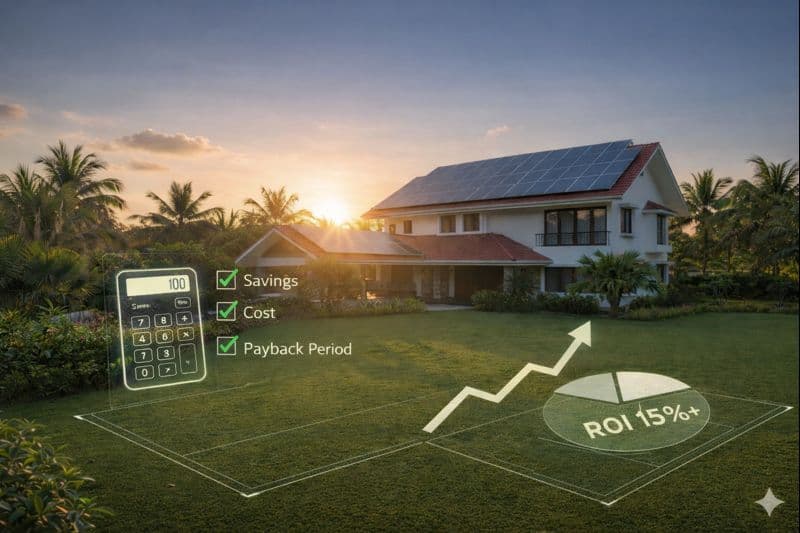
Why Understanding Solar ROI Matters Before You Invest
With rising electricity costs and growing environmental concerns, solar energy has become one of the most reliable long-term investments for homeowners and businesses. However, before installing a solar panel system, it is crucial to understand Solar ROI (Return on Investment) and the payback period.
Solar ROI helps you determine:
- How much you save every year
- How fast your system recovers its initial cost
- When your electricity becomes virtually free
Using a solar ROI calculator, you can estimate these figures accurately and make confident financial decisions.
What Is ROI in Solar Panel Systems?
Solar ROI measures the return you earn compared to the amount you invest in installing a solar system. It reflects how profitable your solar installation will be over time.
India’s solar growth highlights this potential — solar capacity increased from 2.82 GW in 2014 to over 100 GW by 2025, according to Government of India data.
Key Points to Understand
- Higher electricity savings = higher ROI
- ROI is expressed as a percentage
- Can be estimated before installation and tracked after installation
ROI Formula
ROI (%) = (Annual Savings ÷ Total Installation Cost) × 100
Example:
If your solar system costs ₹2,00,000 and saves ₹25,000 annually:
ROI = 12% per year
What Is the Solar Payback Period?
The solar payback period is the time it takes for your system to recover its installation cost through electricity savings. After this period, all electricity generated is essentially free.
Why It Matters
- Helps choose the most cost-effective system
- Gives clarity on when profits begin
- Allows comparison between different system sizes and panel types
How It Works
- Calculate total installation cost
- Estimate yearly savings from reduced bills and net metering
- Divide cost by annual savings
Example:
System cost: ₹2,00,000
Annual savings: ₹30,000
Payback period: 6–7 years
How to Calculate Solar ROI & Payback Period
Steps to Calculate Solar ROI
- Add total system cost (panels, inverter, wiring, labour, taxes)
- Calculate yearly electricity bill savings
- Add net metering credits (if applicable)
- Apply ROI formula
Example:
Cost: ₹2,40,000
Annual savings: ₹35,000
ROI ≈ 14.6%
Steps to Calculate Solar Payback Period
- Note total installation cost
- Divide by annual savings
- Result = years to break even
Our experts help calculate both ROI and payback accurately to ensure maximum financial benefit.
Factors Affecting Solar ROI
1. System Size & Efficiency
- Larger systems produce more energy
- High-efficiency panels generate more power in limited space
2. Local Sunlight Availability
Regions with higher sunlight naturally deliver better ROI.
For example, Kerala receives 4.5–5.5 kWh/m²/day, ideal for rooftop solar.
3. Installation Cost
Lower upfront cost leads to faster payback.
Costs vary based on system quality, installation complexity, and service provider.
4. Government Incentives
Residential solar subsidies can reduce costs by up to 40%, significantly improving ROI.
5. Net Metering Benefits
Selling excess electricity back to the grid increases annual savings and ROI.
Why Use an Online Solar ROI Calculator?
A solar ROI calculator eliminates guesswork and gives accurate projections.
1. Instant Results
Get ROI and payback estimates within minutes.
2. Customized to Your Usage
Calculations based on:
- Electricity consumption
- Location
- Tariff rates
- Sunlight data
3. Smarter Planning
Compare system sizes, budgets, and subsidy scenarios.
4. Better Financial Clarity
Understand:
- Annual savings
- Break-even timeline
- Long-term benefits over system lifespan
FAQs
1. How long does it take to recover solar investment?
Typically 5–8 years, depending on system size, subsidies, and usage.
2. What is a good solar ROI?
Anything above 10% is good; with subsidies, ROI can reach 15–20%.
3. What lowers solar ROI?
Low sunlight, poor-quality panels, high costs, and lack of incentives.
4. Does location affect solar ROI?
Yes. Higher sunlight = higher energy generation = better ROI.
5. Is solar investment profitable?
Yes. After payback, you enjoy 10–15 years of free electricity.
Conclusion
Calculating your solar ROI online using a solar ROI calculator is the smartest way to plan your solar investment. It helps you estimate returns, understand subsidy benefits, and maximize savings with confidence.
With expert guidance and accurate calculations, solar becomes not just an eco-friendly choice — but a powerful financial investment toward energy independence.