India’s Renewable Energy Transition
India is rapidly expanding its renewable energy capacity to meet rising electricity demand and reduce dependence on fossil fuels. With increasing peak power consumption across urban and rural regions, decentralized solar solutions are becoming a key part of the country’s energy strategy.
Two major government initiatives driving this transformation are:
- PM Surya Ghar Muft Bijli Yojana – for residential rooftop solar systems
- PM-KUSUM Yojana – for farmers and agricultural solar pumps
Although both schemes promote solar adoption, they serve different beneficiaries and operate through distinct implementation frameworks.
Let’s explore both in detail.
Part 1: PM Surya Ghar Muft Bijli Yojana
What Is PM Surya Ghar?
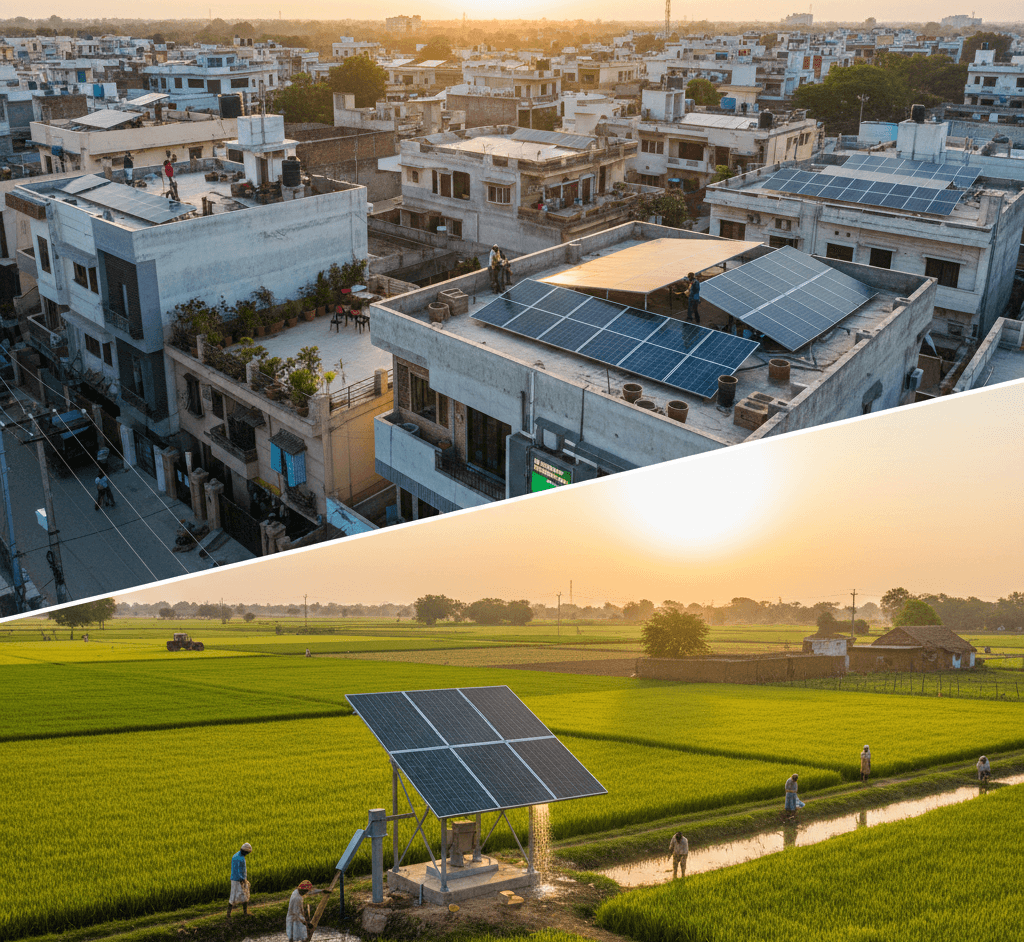
PM Surya Ghar Muft Bijli Yojana is a government initiative designed to promote rooftop solar installations for residential households. The objective is to enable homes to generate their own electricity and reduce monthly electricity bills.
The scheme is implemented through:
• Ministry of New and Renewable Energy (MNRE)
• State nodal renewable agencies
• DISCOMs (electricity distribution companies)
Why This Scheme Matters for Households
Residential electricity demand continues to grow due to:
• Increased appliance usage
• Rising energy costs
• Higher summer consumption
Rooftop solar systems help households:
• Reduce electricity bills
• Protect against tariff increases
• Export surplus energy through net metering
• Contribute to clean energy generation
Subsidy Structure
Under the scheme:
• Subsidy is available for systems up to 3 kW and beyond
• Financial assistance is linked to system capacity
• Subsidy is transferred directly to the beneficiary’s bank account
The subsidy significantly reduces upfront installation costs.
How to Apply for PM Surya Ghar (Step-by-Step)
Step 1: Visit the Official National Solar Portal
Register through the government’s rooftop solar portal.
Step 2: Registration
Provide:
• Mobile number
• Electricity consumer number
• Distribution company details
Step 3: Submit Application
Upload required documents:
• Latest electricity bill
• Aadhaar card
• Bank account details
• Proof of property ownership
Mention the proposed system capacity.
Step 4: Technical Feasibility Approval
The distribution company evaluates:
• Roof suitability
• Transformer capacity
• Grid compatibility
Once approved, installation can proceed.
Step 5: Installation by Empaneled Vendor
Select an approved vendor listed on the portal. Installation must comply with MNRE standards.
Step 6: Net Meter Application
Apply for installation of a net meter to measure exported and imported power.
Step 7: Inspection & Commissioning
Officials inspect the system before activation.
Step 8: Subsidy Disbursement
After commissioning and verification, the subsidy is credited directly to your bank account.
Common Mistakes to Avoid
• Installing without official approval
• Choosing non-empaneled vendors
• Incomplete documentation
• Incorrect consumer category selection
Part 2: PM-KUSUM Yojana
What Is PM-KUSUM?
PM-KUSUM is a government initiative aimed at promoting solar energy in agriculture. It supports:
• Standalone solar-powered pumps
• Solarization of existing grid-connected agricultural pumps
• Decentralized solar power plants
The scheme reduces farmers’ dependence on grid supply and diesel-powered irrigation.
Why PM-KUSUM Is Important
Agricultural irrigation often faces challenges such as:
• Unreliable electricity supply
• High diesel costs
• Seasonal water demand
Solar pumps provide:
• Daytime reliable irrigation
• Reduced fuel expenses
• Lower operational costs
• Sustainable farming practices
Subsidy Structure Under PM-KUSUM
The financial model typically includes:
• 30% Central subsidy
• 30% State subsidy
• 30% Bank loan
• 10% Farmer contribution
(Structure may vary depending on implementation phase.)
How to Apply for PM-KUSUM (Step-by-Step)
Step 1: Check Eligibility
Applicants must:
• Be registered farmers
• Own agricultural land
• Have irrigation requirements
Step 2: Submit Application
Apply through:
• Designated renewable energy portal
• Agriculture department
• Nodal renewable agency
Documents required:
• Aadhaar card
• Land ownership records
• Bank account details
• Pump capacity requirement
Step 3: Technical Evaluation
Authorities verify:
• Borewell or water source feasibility
• Pump capacity
• Solar panel capacity required
• Site inspection
Step 4: Approval & Vendor Selection
After approval:
• Select empaneled vendor
• Finalize cost estimate
• Initiate loan processing (if required)
Step 5: Installation
Vendor installs:
• Solar panels
• Pump motor
• Controller
• Mounting structure
System performance is tested.
Step 6: Inspection & Subsidy Release
After successful verification:
• Subsidy portion is released
• Loan activated
• Farmer pays remaining contribution
Key Differences Between the Two Schemes
| Feature | PM Surya Ghar | PM-KUSUM |
|---|---|---|
| Target Group | Residential households | Farmers |
| System Type | Rooftop solar | Solar pumps |
| Primary Benefit | Reduced electricity bills | Reliable irrigation |
| Energy Use | Household consumption | Agricultural pumping |
| Financial Support | Direct subsidy | Subsidy + loan model |
Broader Impact on India’s Energy System
Together, these schemes:
• Promote decentralized solar generation
• Reduce peak demand pressure
• Support clean energy targets
• Improve rural energy reliability
• Lower carbon emissions
Residential rooftop solar stabilizes urban demand, while agricultural solar pumps reduce stress on rural feeders.
Practical Considerations Before Applying
For Homeowners
• Ensure roof is shadow-free
• Check structural strength
• Compare vendor quotations
• Understand net metering policy
For Farmers
• Assess water availability
• Choose correct pump capacity
• Understand loan terms
• Confirm maintenance support
Long-Term Benefits
If widely adopted:
• Households reduce long-term electricity costs
• Farmers gain energy independence
• Government reduces reliance on costly power procurement
• Renewable capacity increases sustainably
• Grid stability improves
These schemes are long-term structural reforms in India’s energy landscape.
Conclusion
PM Surya Ghar enables households to generate their own electricity and reduce dependency on conventional grid power.
PM-KUSUM strengthens the agricultural sector by providing reliable, solar-powered irrigation solutions.
While one focuses on residential energy savings, the other supports sustainable farming practices.
Both schemes promote clean energy adoption and reduce pressure on the national power infrastructure.
Understanding the application process and eligibility criteria helps beneficiaries make informed decisions and fully utilize these solar initiatives.